


US economy grew at 2.1% in first quarter
Commerce Department releases final GDP estimate for first quarter of 2026

Tomas Philipson: Everyone thinks this is a great sign for the economy
Former Council of Economic Advisors acting chair Tomas Philipson discusses the price of crude oil and the Middle East conflict on 'The Bottom Line.'
The U.S. economy grew at a faster pace than expected in the first quarter, according to the Commerce Department's estimate.
The Bureau of Economic Analysis (BEA) on Thursday released its final reading of first-quarter GDP, which showed the economy grew at an annualized rate of 2.1% in the three-month period including January, February and March.

The Commerce Department released its final estimate of first-quarter GDP on Thursday. (Brandon Bell/Getty Images)
That figure was higher than the expectations of economists polled by LSEG, who had estimated 1.6% GDP growth in the first quarter. The figure was initially estimated at 2% before it was lowered to 1.6% in the BEA's first revision.
US ECONOMY GREW AT 0.5% IN FOURTH QUARTER
It comes after the U.S. economy grew at a rate of roughly 2.1% in 2025. The second half of last year saw 4.4% annualized growth in the third quarter and 0.5% in the fourth quarter.
The BEA reported that the main categories that contributed to the rise in real GDP in the first quarter were investment, exports, government spending and consumer spending. Imports increased in the first quarter.
Across industries, the biggest contributors to GDP growth were the information technology sector; the federal government; professional, scientific and technical services; and durable goods manufacturing. The main offsets to GDP were declines in retail trade, wholesale trade, along with finance and insurance.
FED'S FAVORED INFLATION GAUGE ACCELERATED IN MAY AMID ENERGY PRICE SHOCK
Much of the investment in the information sector was directed toward information processing equipment and computers amid the artificial intelligence (AI) buildout. Investments in software as well as research and development.
Real final sales to private domestic purchasers, which is the sum of consumer spending and gross private fixed investment, rose 1.7% in the first quarter after a downward revision of 0.7 percentage points from the previous estimate. That figure is down from a 1.8% reading in the fourth quarter of 2025 and 2.8% in the third quarter last year.
FEDERAL RESERVE LEAVES INTEREST RATES UNCHANGED AS WARSH ERA BEGINS
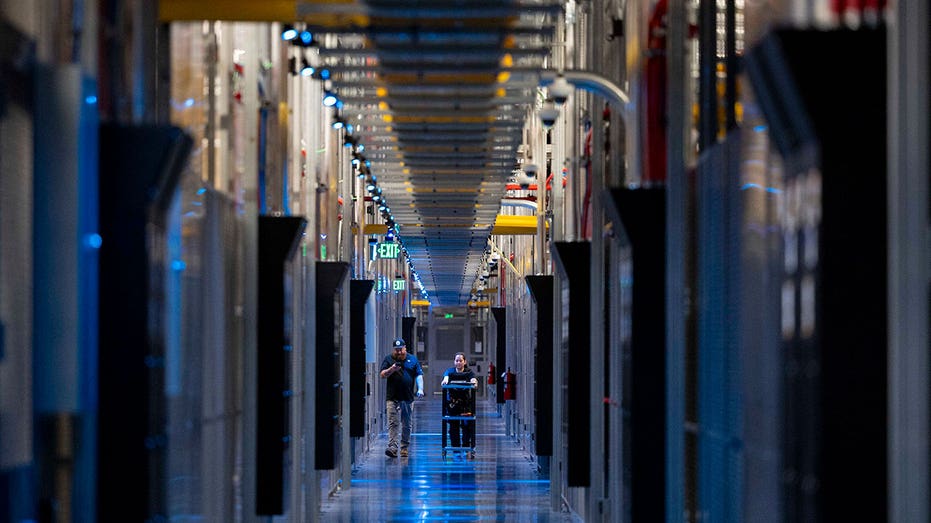
Investment in data centers has contributed to the rise in real GDP. (Amanda Andrade-Rhoades for The Washington Post via Getty Images)
What experts are saying
EY-Parthenon chief economist Gregory Daco noted that the final first quarter GDP data "reveals softer final demand growth, with consumer spending increasingly supported by a drawdown in savings, greater use of credit and household wealth."
"Overall, the U.S. economy remains resilient, but the foundation of growth has become narrower. Interest-rate-sensitive sectors continue to struggle under elevated financing costs, while an income squeeze driven by slower wage growth and higher inflation is constraining consumer spending," Daco said. "Business investment has strengthened, supported by AI-related capital spending, but housing activity remains in the doldrums."
Daco added that the firm expects energy supplies to gradually normalize with oil prices likely to stay above their pre-Iran war levels through the end of the year. The firm forecasts slower growth and sticky inflation, with real GDP growth of around 1.9% in 2026 and 2027.
GET FOX BUSINESS ON THE GO BY CLICKING HERE
Bill Adams, chief U.S. economist at Fifth Third Commercial Bank, noted that there were "dated downward revisions to consumer spending" in the GDP data.
"Even so, growth is fast enough to keep up with workforce entrants and hold the unemployment rate steady. Just as important, the outlook has improved now that energy is flowing through the Strait of Hormuz again," Adams said.